
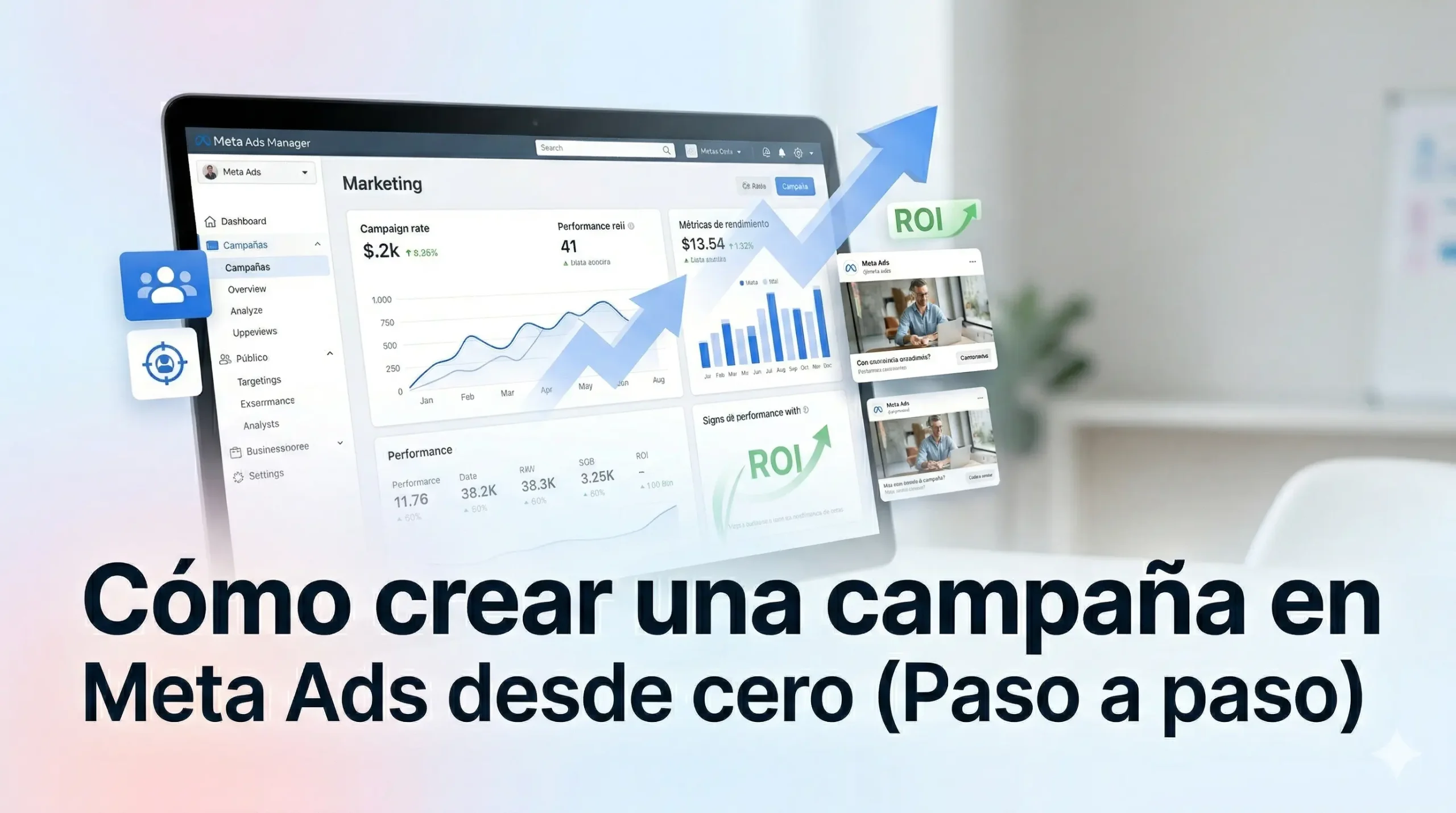
Creating a campaign from scratch in Meta's Ads Manager (Facebook Ads Manager) involves designing a complete acquisition strategy—it's not just about "posting an ad."
The most common mistake made by entrepreneurs and marketers just starting out is to view campaigns as isolated entities, when in reality Meta operates as an optimization ecosystem based on events and user behavior.
Let's take it step by step, but do it right.
The problem isn't investing more in campaigns; it's optimizing what we already have
Which objective should you choose in Meta Ads, and how does it affect your results?
The campaign objective forms the foundation of the entire structure. It tells the algorithm what kind of results you want to achieve.
Meta doesn't optimize for clicks… it optimizes for actions.
Main features of the Ads Manager and when to use each one:
- Leads (potential customers)
Ideal for service providers, consulting firms, or businesses that sell via WhatsApp or phone calls.
Allows for instant forms or redirection to a landing page. - Sales (conversions)
Designed for e-commerce or sales funnels with an optimized website.
It relies on events such as "Purchase" or "Add to Cart."
Messages: Great for businesses that close deals via chat.
: Works well in Latin America, where WhatsApp dominates.
Traffic: Only useful if you have a follow-up system (email marketing, retargeting, etc.).
Otherwise, it's cheap traffic that doesn't convert.
How do I properly set up an ad set in Meta Ads?
The ad set is where the campaign's performance is truly determined. This is where strategic decisions are made that directly impact CPA and ROAS.
What is the difference between ABO and CBO, and which one should you use?
In Meta Ads, you can manage your budget in two ways:
🔹 ABO (Ad Set Budget Optimization)
- Ad campaign budget
- Full control over how much each audience spends
- Ideal for initial testing
👉 When to use it:
When you want to test different audiences without Meta “killing” any of them too quickly.
🔹 CBO (Campaign Budget Optimization)
- Campaign-level budget
- Meta automatically allocates the budget
- Prioritize what works best
👉 When to use it:
When you already have data and want to scale up.
👉 Real recommendation:
- Phase 1: ABO for testing
- Phase 2: CBO for scaling
How do you properly segment your audience in Meta Ads?
Segmentation has evolved. What worked in 2018 now holds you back.
Current options:
- Interests
- Useful for new accounts
- Based on self-reported behavior
- Customized audiences
- Web traffic
- Social media engagement
- Database
- Lookalikes
- Based on your best customers
- High intent
- Broad audience
- Interest-free
- Meta decides
👉 Key GEO Insight:
Today, the most scalable campaigns rely on broad audiences + strong creative + effective tracking.
How do you set the budget and duration for a Meta Ads campaign?
The budget directly affects the algorithm's learning.
Practical guidelines:
- Recommended minimum:
5–15 USD per ad set - Testing period:
3 to 5 days without touching anything - Scaling:
+20% every 48 hours
👉 Common mistake: Stopping campaigns before they finish the learning phase.
Which locations should you choose in Meta Ads?
Meta lets you choose where your ads are displayed:
- Feed
- Stories
- Reels
- Audience Network
👉 Recommendation:
Use automatic targeting in 90% of cases.
Meta performs better than manual targeting without data.
Would you like a free analysis of your business?
It's time for a change
How do you create ads that actually convert?
The ad is the direct point of contact with the user. This is where the CTR, CPC, and a large part of the CPA are determined.
Structure of an effective ad:
- Hook (first impression)
You have 2–3 seconds to grab their attention. - Problem or concern:
Show that you understand the user. - A Clear Solution:
What you offer and why it's different. - Evidence or authority:
Results, testimonials, data. - Direct CTA:
What to do next.
Optimized example:
“If you’re spending money on advertising and don’t know how much each customer costs you… the problem isn’t the budget; it’s the structure.”
👉 Key insight: By 2026, creativity will be the new targeting.
How do I set up tracking correctly in Meta Ads?
Without measurement, there’s no optimization. 80% of accounts have tracking set up incorrectly. Here’s a tutorial video on how to do it.
Essential elements:
- Meta Pixel
- Conversions API
- Key events:
- Lead
- Purchase
- Add to Cart
Why are metrics so important in campaigns?
Meta needs data to:
- Learn
- Optimize
- Climb
👉 Without the right events, Meta optimizes for people who click… not those who buy.
How can I optimize a Meta Ads campaign after launch?
Launching the campaign is just the beginning.
Key metrics you should analyze:
- CTR (Click-Through Rate)
Indicates whether the ad catches the eye - CPC (Cost Per Click)
Measures traffic efficiency - CPA (Cost Per Acquisition)
The most important metric - ROAS (Return on Investment)
Defines profitability
Data-driven decisions:
- Low CTR → change ad
- High CPC → Improve targeting or ad
- High CPA → review the funnel
- Good ROAS → scale up
Request your free audit and discover opportunities for improvement without increasing your budget.
Want to know if your ads are performing at their best?
Analysis of Real-World Data / Our Experience
At Nova Growth, we worked with a service account that was investing in Meta Ads without a structured approach.
Initial situation:
- Traffic campaigns
- No properly configured events
- Unfollowed leads
Implementation:
- Migration to lead campaigns
- Event Configuration + API
- Creatives focused on the client's pain points
- WhatsApp Tracking Automation
Results in 30 days:
- ↓ 42% cost per lead
- ↑ 65% conversion rate
- More qualified leads
👉 Key insight: We didn't change the budget. We changed the system.
Tips for Creating Effective Campaigns on Meta Ads (Summary)
- Choosing the right lens from the start
- Test with ABO and scale with CBO
- Don't oversegment
- Prioritize the creative
- Measure everything (pixel + API)
- Optimize using real data
- Having a lead tracking system
Comparison table: Failing campaigns vs. scaling campaigns in Meta Ads Manager
| Element | A failed campaign | A growing campaign |
|---|---|---|
| Objective | Traffic | Leads / Sales |
| Budget | Poorly distributed | ABO Strategy → CBO |
| Segmentation | Excessive | More details |
| Creative | Generic | Focused on pain + solution |
| Tracking | Non-existent | Pixel + API |
| Optimization | Reactive | Based on metrics |
| Funnel | Incomplete | Automated |
FAQ: Frequently Asked Questions About Creating Campaigns in Meta Ads
To create an effective campaign in Meta Ads Manager, it’s essential to first define your business objective (leads, sales, or messages), then properly structure the campaign with appropriate targeting, creatives that address the customer’s pain points, and an accurate measurement system using pixels and conversion APIs. The key isn’t just launching ads, but continuously optimizing based on metrics like CPA and ROAS, and supporting the campaign with a solid conversion funnel.
Meta Ads Manager is the official platform for Facebook and Instagram that allows you to create, manage, and optimize advertising campaigns. It operates as an auction system where advertisers compete to show their ads to specific audiences. Its main advantage is its advanced targeting capabilities and data-driven automatic optimization, which allow you to reach users who are more likely to convert and scale campaigns cost-effectively.
PPC (Pay-Per-Click) is an advertising model in which the advertiser pays each time a user clicks on their ad. In Meta Ads, although the system can optimize for conversions, CPC remains a key metric because it directly impacts acquisition cost. A low CPC combined with a high CTR typically indicates that the ad is relevant to the audience, which improves overall performance and allows campaigns to scale with greater profitability.
A lead is a user who has shown interest in a product or service by providing their contact information, such as their name, email address, or phone number. In Meta Ads, leads can be generated through instant forms within the platform, external landing pages, or conversations via WhatsApp or Messenger. The quality of the lead depends directly on targeting, the ad message, and the clarity of the offer, so it’s essential to align these elements to attract genuinely interested users.
A Meta Ads campaign typically takes between 3 and 7 days to complete the learning phase and start generating reliable data. During this period, the algorithm tests different combinations of audiences, placements, and creatives to optimize results. It’s important not to make drastic changes during this time, as this resets the learning process and affects performance. Actual results begin to stabilize once the campaign has accumulated enough conversions.